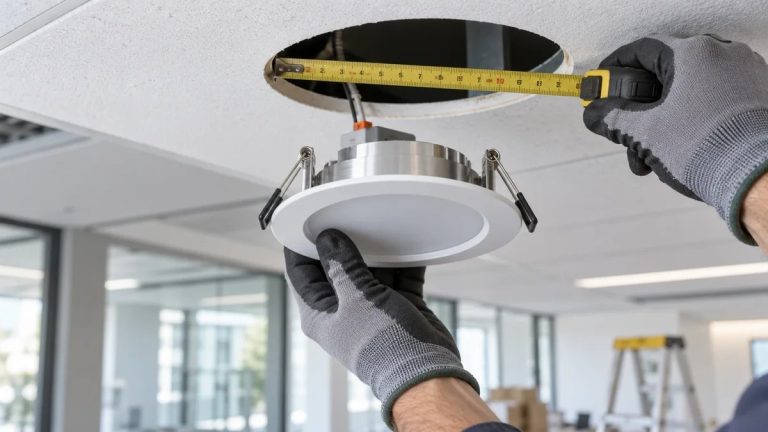
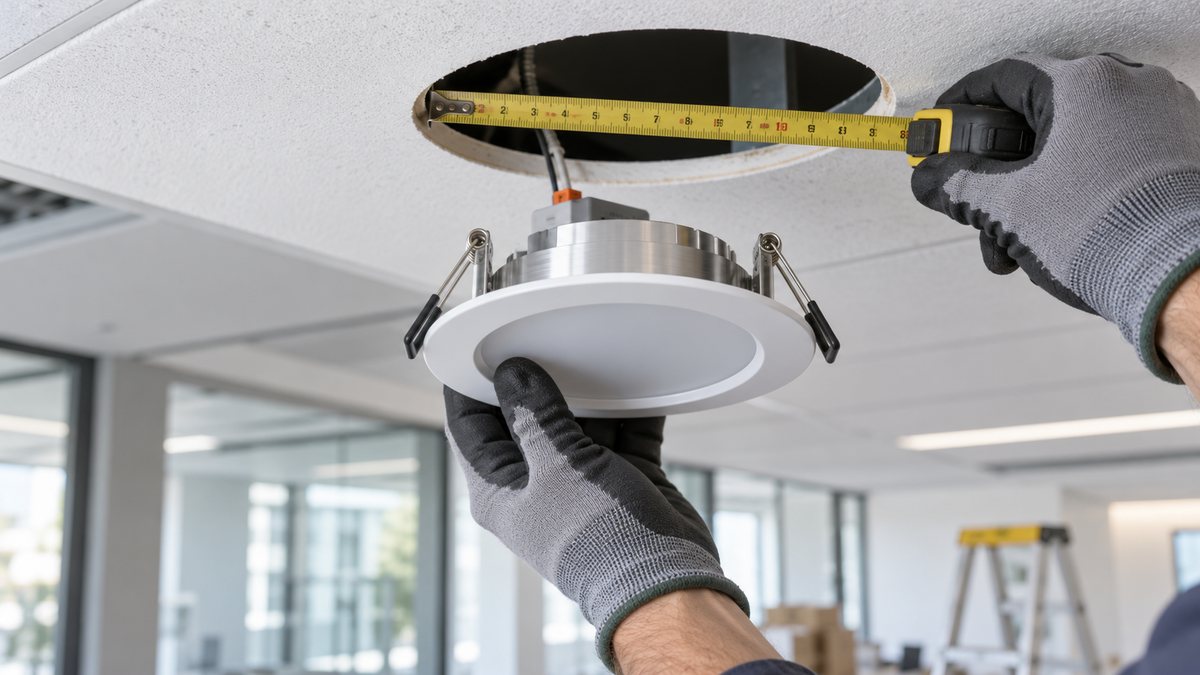
A nominal diameter starts the comparison; the finished hole decides whether the assembly enters. Removing the old lamp may reveal a broken edge, framing near a spring, or a connector wider than the driver case. Follow the fitting as an installer handles it. Start by passing the wired components upward, then turn the housing through the cutout while holding the springs close to its sides. When movement first becomes tight, stop while the contact point is still visible; pushing farther or partly withdrawing the lamp can shift a spring and hide the cause.
What Should Be Measured at the Existing Opening?
With the old fitting out, rotate the measuring axis across the centre instead of relying on one reading. Filler may narrow the hole at one point while a previous clip has broken material away elsewhere. Keep the smallest and largest results.
Read the hole from more than one direction
The smallest reading controls passage of the body. The widest axis shows how much trim overlap remains and how much board is available under the clips. It answers a different question from the minimum. A broad bezel may cover surface breakout, yet the springs still load the material surrounding the hole. Crumbling or flexible board needs an agreed repair or mounting detail before it is asked to support the fitting.
Check the space directly above the cut edge, noting nearby framing, services, insulation, and reinforcement. Mark each obstruction by clock position; a clip moving at three o’clock is not helped by clear space at nine o’clock.
Why Can Spring Clips Stop an Otherwise Suitable Body?
As the lamp rises, each spring changes from lying alongside the housing to bearing across the rear face of the ceiling. Its moving envelope can extend beyond the final lamp outline.
Compare what happens at each side
Suppose the body enters but the trim remains evenly below the surface. Leave the cutout unchanged until both spring positions are known. They may be held between layers or lack room to turn outward. One loose sheet does not reproduce the interfaces created by double board, an acoustic panel, a metal face, or a reinforcement ring.
An uneven trim points elsewhere. On the hanging side, the spring may have met a channel, service, or damaged edge. Ease the fitting down and inspect that spring before another push breaks more board.
A flush lamp can still be loose if a spring bears on weak material or remains partly folded. A gentle movement check at the trim exposes this support problem.
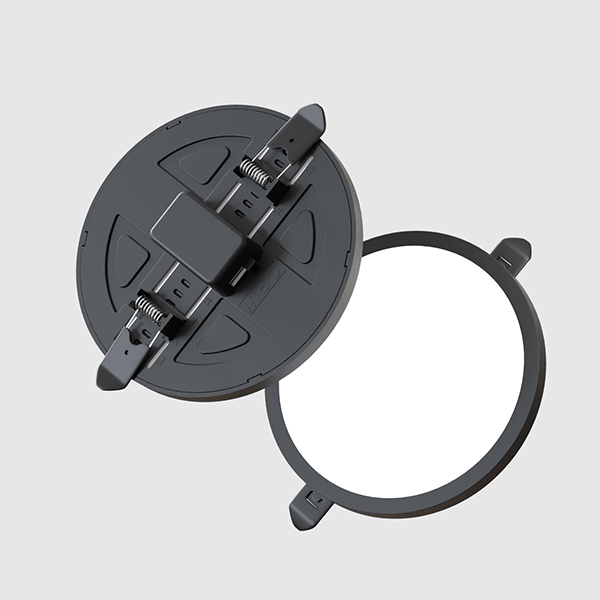
Will the Driver, Connector, and Cable Pass as Installed?
The access hole also serves the driver, terminal enclosure, connector, and cable. They go above the ceiling before the lamp and need a route back to the opening for service. The driver is usually turned, fed through one end first, and guided sideways.
Use the assembled parts
Try the turn with the complete assembly because a connector can catch after the bare enclosure has passed. Additional void depth does not create side clearance when framing blocks that turn.
Test removal separately. Bring the driver from its resting position back to the cutout. The cable must let it reach and turn without pulling on a terminal. If retrieval requires opening a concealed joint or enlarging the hole, the service path has failed.
This exercise addresses space and movement, not thermal, fire, acoustic, or airtight performance. Keep insulation and barriers in their specified positions unless the responsible party accepts a change.

Where Did the Mock-Up First Make Contact?
At the first resistance, withdraw the lamp carefully. A rub beside the narrow axis points to body clearance; a mark above the board in line with a spring points to its travel or ceiling thickness. Scuffing on the plug or enclosure sends the check back along the route used by the wired components.
Read contact marks before changing the hole
Run the fitting through the same motion at a slower pace. When the rigid housing reaches the cut edge before the springs, check that local opening width against the widest fixed projection. If the housing clears and a spring stops, inspect behind that position and through every ceiling layer. A larger bezel cannot help a driver that will not rotate through the opening.
Avoid cutting while the cause is still uncertain. Enlarging the hole can remove the tight edge or contact mark that showed what happened. The remedy may be an edge repair, an accepted adapter, another clip arrangement, a different driver position, or another fitting—not automatically a larger cutout.
After a change to the body, spring location, driver case, connector, or cable exit, repeat the affected movement. A familiar model name does not guarantee the same installation envelope.
What Should Be Exchanged Before the Cutting Schedule Is Released?
Send the smallest and largest opening measurements, edge damage and obstruction positions, finished layers and thickness, available depth, and intended service route. Also mark any insulation, fire, acoustic, or airtight element that the fitting must not disturb.
Describe the ceiling as it stands
The matching drawing needs the opening requirement, trim diameter, fixed housing extremes, spring locations, driver and connector size, and cable-exit direction for the quoted item. A family catalogue may group several versions whose castings or electrical parts are not mechanically identical, so the project needs the drawing tied to its selection.
Fit the sample into the completed ceiling build-up. Check the remaining edge, both springs, and whether the trim rocks; then return the driver and connector through the access route before identical holes are repeated.
How Can Lionway Support the Mechanical Review?
Lionway Electronics Co., Limited. identifies lighting design, mold development, manufacturing, optical-laboratory work, and testing among its operations. Its public page describes the Heavenly Craftsmanship down light as ultra-thin and intended for quick installation. The page does not state a project cutout range or ceiling-thickness limit; obtain those details from the drawing for the offered version. Send the ceiling section and opening range with the locations of obstructions, available void, access requirement, and quantity. The drawing and sample can then be compared with a defined ceiling condition.
Conclusion
Ceiling compatibility is revealed by movement. The useful observations are physical and local: the narrow axis that catches a housing, the layer that traps both springs, the channel behind one clip, or the connector that cannot turn back through the hole. Watching where that sequence breaks turns a vague fit problem into a specific mechanical question before repeated cutting makes the problem larger.
FAQs
1. Can trim diameter be used as the cutout size?
No. Trim diameter describes the visible part covering the edge. The opening used by the housing may be smaller and is identified separately on the fitting drawing. Use the labeled drawing for the offered fitting.
2. Why might one edge of the trim remain away from the ceiling?
Concentrate on the spring beside that edge. Its travel may be blocked by a service or channel, interrupted by broken board, or held within one layer of the ceiling. Lower the lamp gently and inspect the spring path before altering the cutout.
3. Does a successful installation test prove the driver can be serviced?
No. Push-in access and pull-out access are not equivalent. With the connector and cable attached, retrieve the driver from its intended position and watch whether it can reach and turn through the opening.
4. What changes call for another fit test?
Test again if the ceiling layers or nearby obstruction changes. Do the same after a revision to the housing, clips, driver, connector, or cable outlet affects the movement through the opening.